
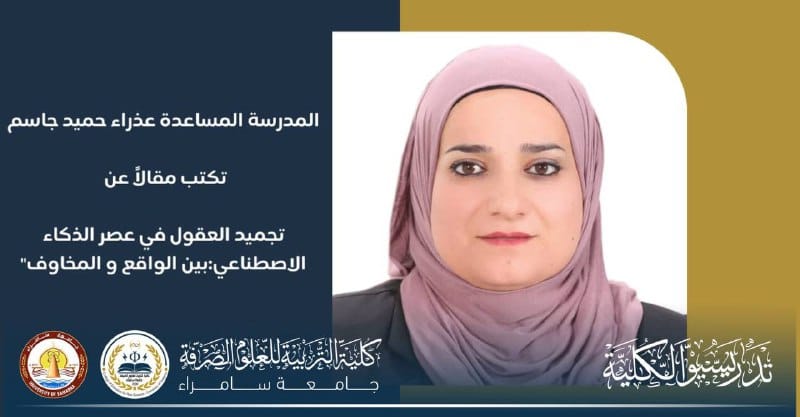
A Faculty Member in the Department of Life Sciences Writes an Article on the Freezing of Minds in the Age of Artificial Intelligence
Assistant Lecturer Adhra Hamid Jasim, a faculty member in the Department of Life Sciences at the College of Education for Pure Sciences – University of Samarra, wrote an article titled “Freezing of Minds in the Age of Artificial Intelligence: Between Reality and Concerns.”
At a time when the world is witnessing an unprecedented boom in artificial intelligence technologies—which have become an integral part of our daily lives in education, industry, medicine, and even decision-making, in addition to greatly facilitating many tasks—excessive reliance on them threatens to cause mental stagnation and a halt in self-driven productivity. A student who relies on ready-made answers instead of research and analysis, or a writer who waits for algorithms to generate ideas rather than investing their own creative energies, may develop weakness in memory and information retention. This, in turn, leads to a decline in intellectual and human capacities as a result of overdependence on intelligent systems.
Our memory is not merely a repository; rather, it is a vital system closely linked to thinking and comprehension. Neglecting it leads to a less flexible mind and a reduced ability to build new cognitive connections. This raises the question: Does artificial intelligence really freeze minds? Artificial intelligence does not freeze the mind in itself; rather, the way humans use it is what determines that. When used as a tool to enhance thinking, it stimulates the mind, but when relied upon as a substitute for thinking, it freezes mental capacities. Thus, the real danger lies not in the power of artificial intelligence itself, but in human weakness before it and the abandonment of natural abilities in research and creativity.
Therefore, we must build a complementary relationship with this technology; otherwise, we may face a generation that lacks intellectual abilities and threatens our future with the risk of early Alzheimer’s disease. Technology should be a means to expand the mind, not to freeze it, and it is our responsibility—both as individuals and institutions—to strike a balance between benefiting from it and preserving our intellectual and creative capacities.
#College_of_Education_for_Pure_Sciences_University_of_Samarra
#University_of_Samarra