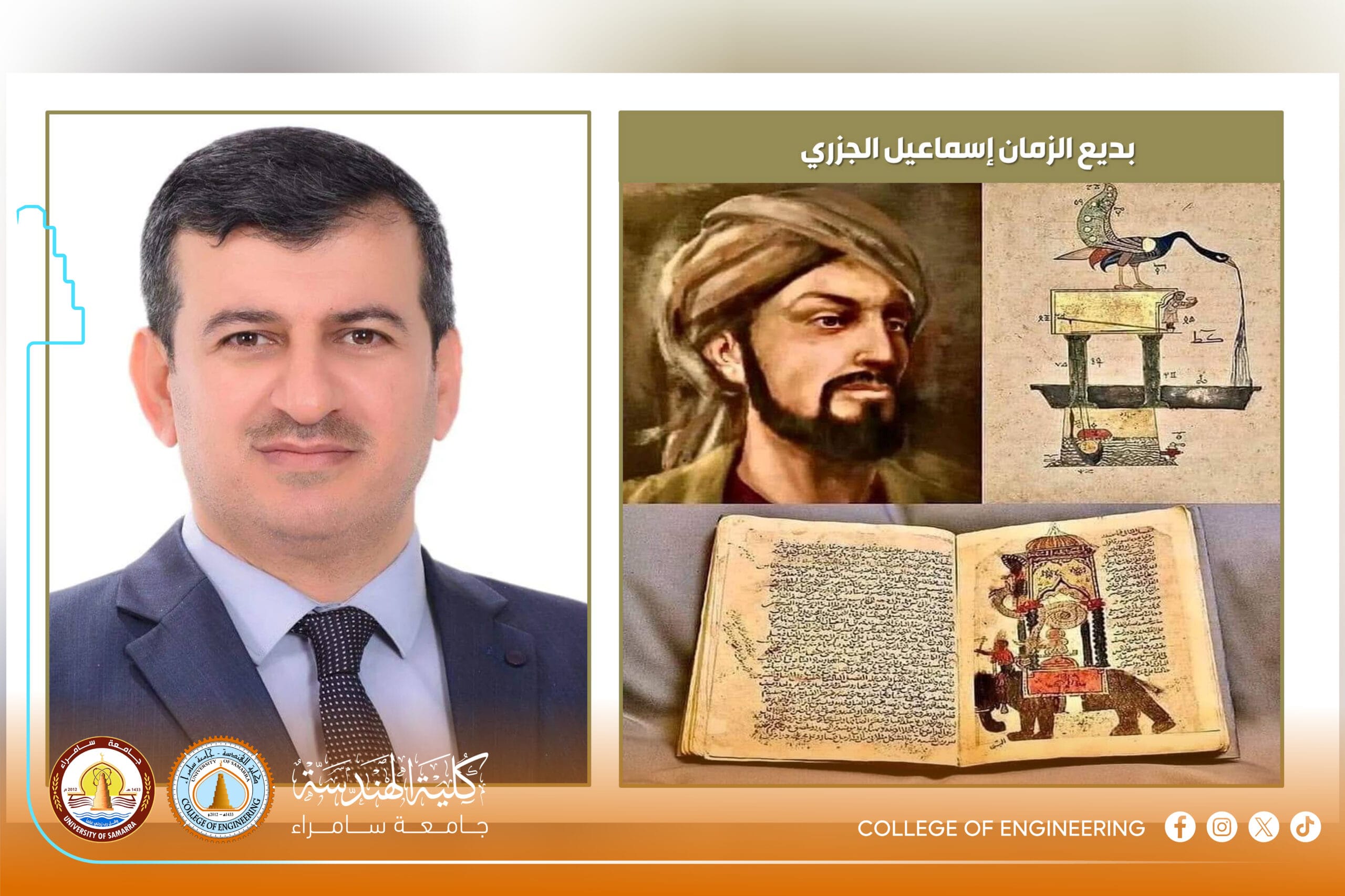
Between the Fragrance of History and Contemporary Engineering Ambition: The Dean of the College of Engineering Publishes a Scientific Article Highlighting Al-Jazari’s Genius
The Dean of the College of Engineering at the University of Samarra, Assistant Professor Dr. Amjed Saleh Mahmood, presented an in-depth scientific and research article delving into the life and innovations of the brilliant scholar “Badi’ al-Zaman Abu al-Izz bin Ismail al-Jazari.” The article highlights his status as one of the greatest engineering minds known to humanity in the late 6th century AH.
In his article, the Dean explained that Al-Jazari was not merely a transient engineer, but a pioneer who preceded his time by centuries in formulating concepts of automation, autonomous control, and robotics. He laid the foundation for today’s technological and precision mechanical renaissance, outshining Western figures who gained fame in later eras.
Furthermore, the Dean noted that Al-Jazari embodied a unique model of the polymath who merged scientific rigor with artistic beauty. He succeeded in inventing self-moving machines relying on natural forces such as water, air, and pressure, at a time when the world lacked even the basic elements of modern technology.
The article reverently pointed to the scientific value of his famous book, “The Book of Knowledge of Ingenious Mechanical Devices” (Al-Jami’ bayn al-‘ilm wa-al-‘amal al-nafi’ fi sina’at al-hiyal). This work remains a global engineering reference taught in major international universities due to its precise engineering drawings and applied methodology, which align in essence with modern engineering practices. Al-Jazari did not settle for theory; he provided practical, detailed solutions for mechanical operating mechanisms.
In reviewing the most prominent innovations, the article paused at the genius of complex water clocks, such as the Elephant Clock and the Peacock Clock, which represented the pinnacle of timekeeping combined with artistic display. Additionally, it touched upon his invention of the earliest “robotic” models in history, such as automated service machines and self-flowing ablution systems.
Moreover, the author emphasized that Al-Jazari’s early use of valves, gears, and feedback mechanisms represents the true roots of contemporary mechanical engineering. He cited the appreciation of Western historians, including the British historian Donald Hill, who described Al-Jazari as the greatest mechanical engineer of the Middle Ages.
The Dean concluded his article by stressing that celebrating Al-Jazari’s legacy is a confirmation that engineering is a civilizational science par excellence. The heritage he left behind serves as a living message to future generations that creativity stems from the meeting of imagination with a sober scientific methodology.