
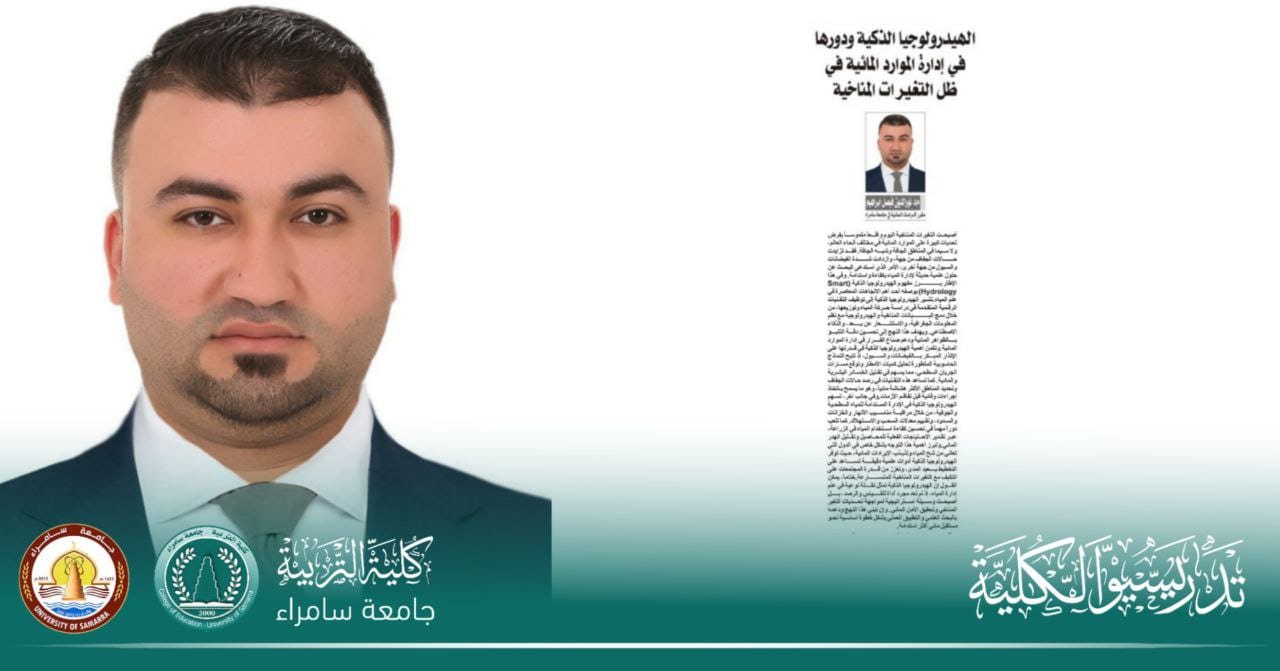
A faculty member in the Department of Geography publishes a scientific article in the Iraqi newspaper Al-Dustour
Assistant Professor Noor Al-Din Faisal Ibrahim, a faculty member in the Department of Geography at the College of Education for Human Sciences – University of Samarra, has published a scientific article in the Iraqi newspaper Al-Dustour entitled “Smart Hydrology and Its Role in Managing Water Resources under Climate Change.”
In the article, the author explains that with accelerating climate change, water resources are facing increasing challenges, particularly in arid and semi-arid regions, which necessitates the adoption of modern scientific and technological solutions to confront its impacts.
From a technological perspective, smart hydrology is considered one of the most prominent modern trends in water sciences. It relies on advanced digital technologies, including Geographic Information Systems (GIS), remote sensing, and artificial intelligence, to analyze water movement and distribution and to integrate climatic data with hydrological data, thereby enhancing the accuracy of forecasting water-related phenomena.
In addition, smart hydrology enables early warning of floods and flash floods through computer models that analyze rainfall amounts and determine surface runoff pathways, reducing human and material losses. It also helps monitor drought conditions and identify areas most vulnerable to water stress, allowing relevant authorities to take proactive measures to prevent crises from worsening.
Beyond risk management, these technologies contribute to the sustainable management of surface and groundwater resources by monitoring river levels, reservoirs, and dams, assessing withdrawal and consumption rates, and improving water-use efficiency in the agricultural sector by estimating actual crop water requirements and reducing waste.
Furthermore, the author emphasizes that smart hydrology represents a qualitative shift in the science of water resources management and highlights the importance of supporting it through scientific research and practical application to enhance societies’ ability to adapt to climate change and ensure long-term water security.