
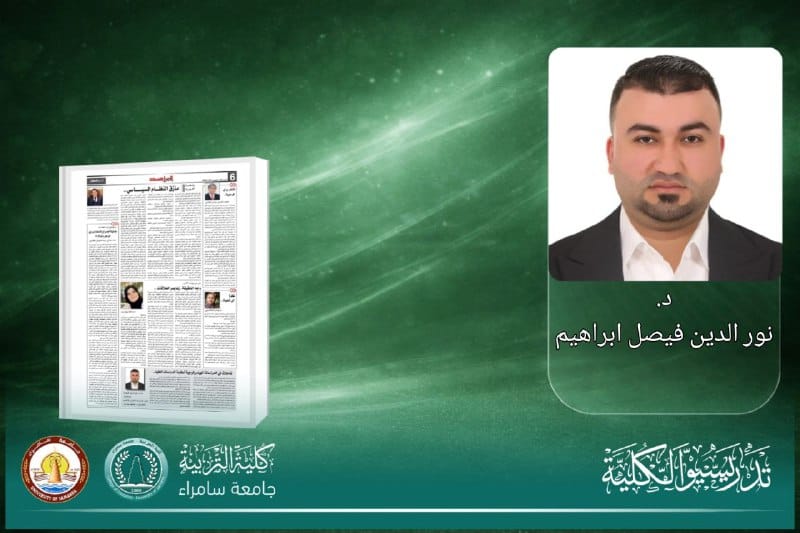
A Faculty Member in the Department of Geography Publishes a Scientific Article in Al-Mada
Newspaper Dr. Nour al-Din Faisal Ibrahim, a faculty member in the Department of Geography at the College of Education for Humanities, University of Samarra, has published a scientific and intellectual article in Al-Mada newspaper, issue No. 33, entitled “Reflections on Hydrological Studies for Graduate Students.” In the article, he outlined the cognitive and methodological dimensions of hydrology and its growing importance in contemporary academic studies. Based on the scientific vision presented by the author, the article explains that hydrological studies are no longer a purely descriptive field limited to the analysis of rainfall and rivers. Rather, they have become a central discipline intersecting with issues of climate change, water security, and sustainable development. This shift requires graduate students to adopt critical and analytical thinking that goes beyond traditional modes of passive learning. On the methodological level, the article points out that modern hydrology is founded on understanding the complex interaction between natural processes and the geographical and human context. It also emphasizes the use of advanced scientific tools such as Geographic Information Systems (GIS), remote sensing, and numerical models, which enhance analytical accuracy and deepen interpretation. From a data interpretation perspective, the author clarifies that hydrological data reflect the interconnection between climate, topography, soil, and human activity. This places a responsibility on researchers to interpret results with scientific rigor, rather than relying solely on abstract numerical outputs. Moving to the human and applied dimension, the researcher stresses the direct connection between hydrological research and community life, water resource management, and the mitigation of flood and drought risks. He underscores that the true value of scientific research is measured by its ability to provide realistic and applicable solutions. In the conclusion, the author emphasizes that hydrology represents a forward-looking science that contributes to understanding present challenges and anticipating the future. He calls on graduate students to approach water as a civilizational resource and a scientific and societal responsibility. Edited by: Hanan Mahmoud Abdul Rahim #College_of_Education_for_Humanities #University_of_Samarra