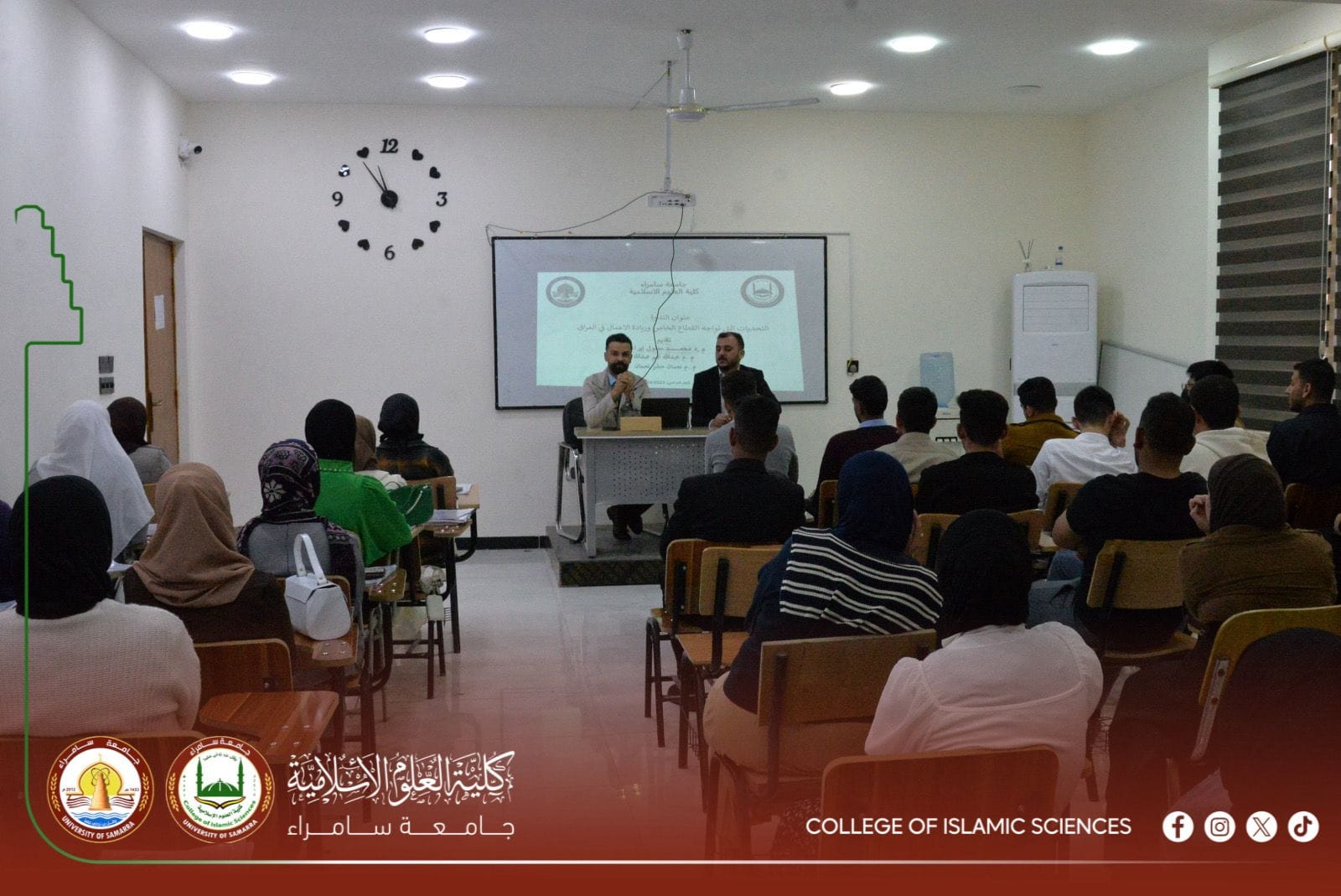
Scientific Course on the Challenges Facing the Private Sector and Entrepreneurship in Iraq
A scientific course titled “Challenges Facing the Private Sector and Entrepreneurship in Iraq” was held on March 30–31. It was delivered by Dr. Mohammed Madlul Ibrahim, Assistant Lecturer Abdullah Najm Abdullah, and Assistant Lecturer Nu‘man Mundhir Nu‘man, as part of efforts to enhance academic and professional awareness of the Iraqi economy and its development prospects.
The course addressed the state of the private sector in Iraq, particularly the transformations it has undergone since 2003 due to the transition to a market economy and economic openness. This shift was accompanied by an increase in small and medium-sized enterprises (SMEs) and an expansion in commercial and service activities.
It also highlighted the continued reliance of the Iraqi economy on the oil and public sectors, which has limited the private sector’s contribution to achieving comprehensive economic development.
Furthermore, the course outlined the major challenges facing the private sector, including political and security instability, weak infrastructure—especially in electricity and logistics—administrative corruption, bureaucracy, and difficulties in accessing finance due to a weak banking system.
The course also discussed the impact of competition with imported goods, as well as the weakness of laws supporting investment and protecting domestic production.
At the conclusion of the course, participants issued several key recommendations, most notably: aligning educational outcomes with labor market needs, creating an attractive investment environment, supporting SMEs, and developing a comprehensive national strategy to activate the private sector and strengthen its role as a key driver of the Iraqi economy.