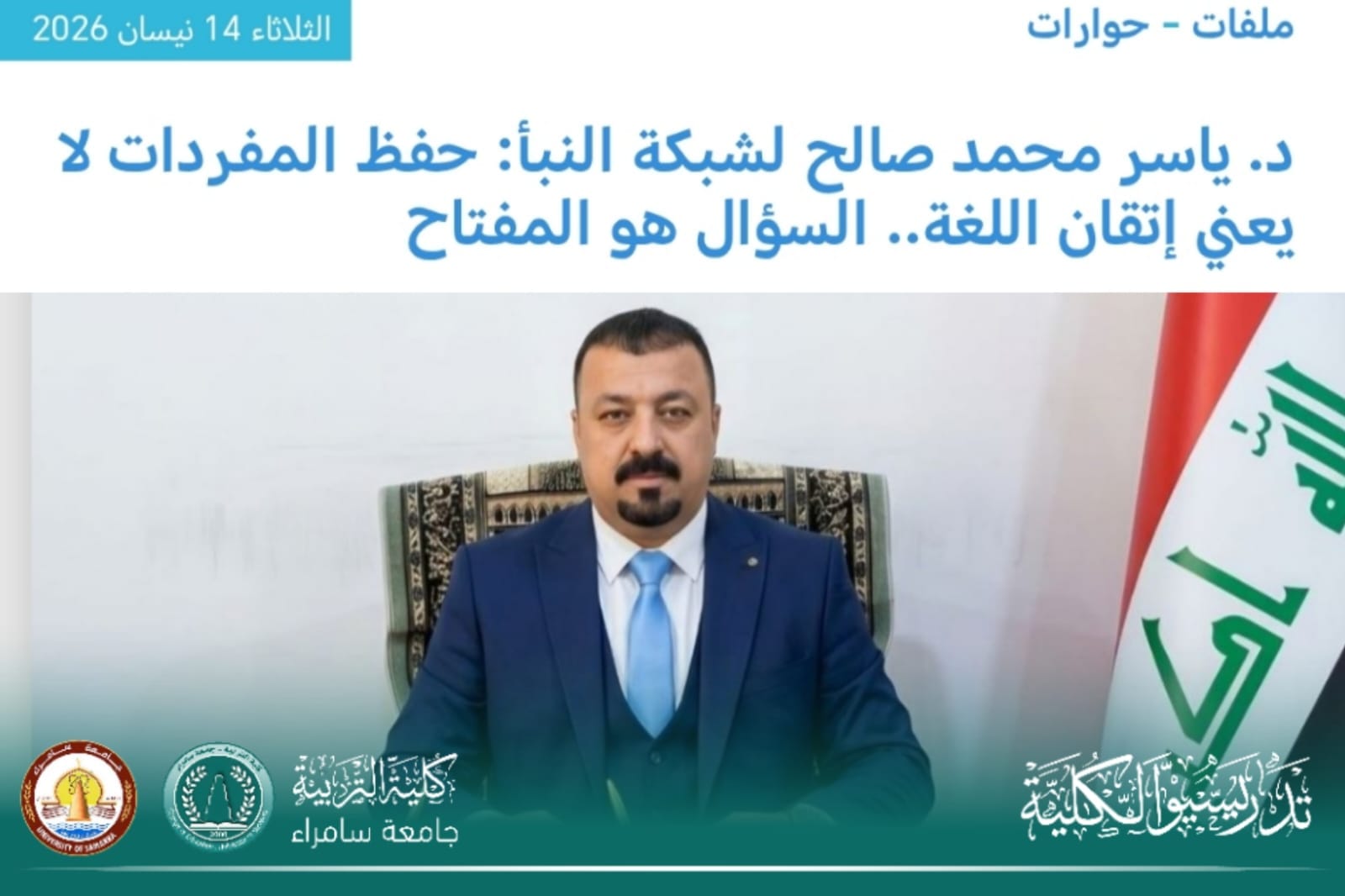
The head of the English department at Samarra University conducts a scientific dialogue on vocabulary memorization with Al-Nabaa Network
The Head of the English Department at the College of Education for Humanities at Samarra University conducted an academic interview with Al-Nabaa Information Network, discussing the challenges of teaching English to students, with a focus on the gap between theoretical knowledge and its practical application in daily communication.
The interview explored the nature of the challenges facing learners, particularly in the skill of formulating questions, which is considered a pivotal indicator of linguistic proficiency. It emphasized that memorizing vocabulary and grammar rules is insufficient unless it translates into the ability to construct meaningful communication based on understanding and context.
The interview further highlighted that one of the most significant shortcomings is the reliance on literal translation from Arabic to English, which leads to unnatural constructions. It stressed the importance of training students to think within the English language system and apply it in real-life situations.
The interview also addressed the differences between academic language and everyday language, explaining the necessity of enabling students to move smoothly between the two levels while considering the cultural dimension in language use, especially in questioning and requesting phrases that require a degree of tact.
He emphasized that developing students’ questioning skills contributes to enhancing their ability to engage in dialogue and think critically, and provides them with effective tools to participate in academic discussions, moving beyond rote memorization and passive learning.
In closing, Saleh stressed that language proficiency begins with its use, and that questioning is the key to learning and the gateway to knowledge. He called for the adoption of interactive teaching methods that focus on practice and genuine communication within the educational environment.