
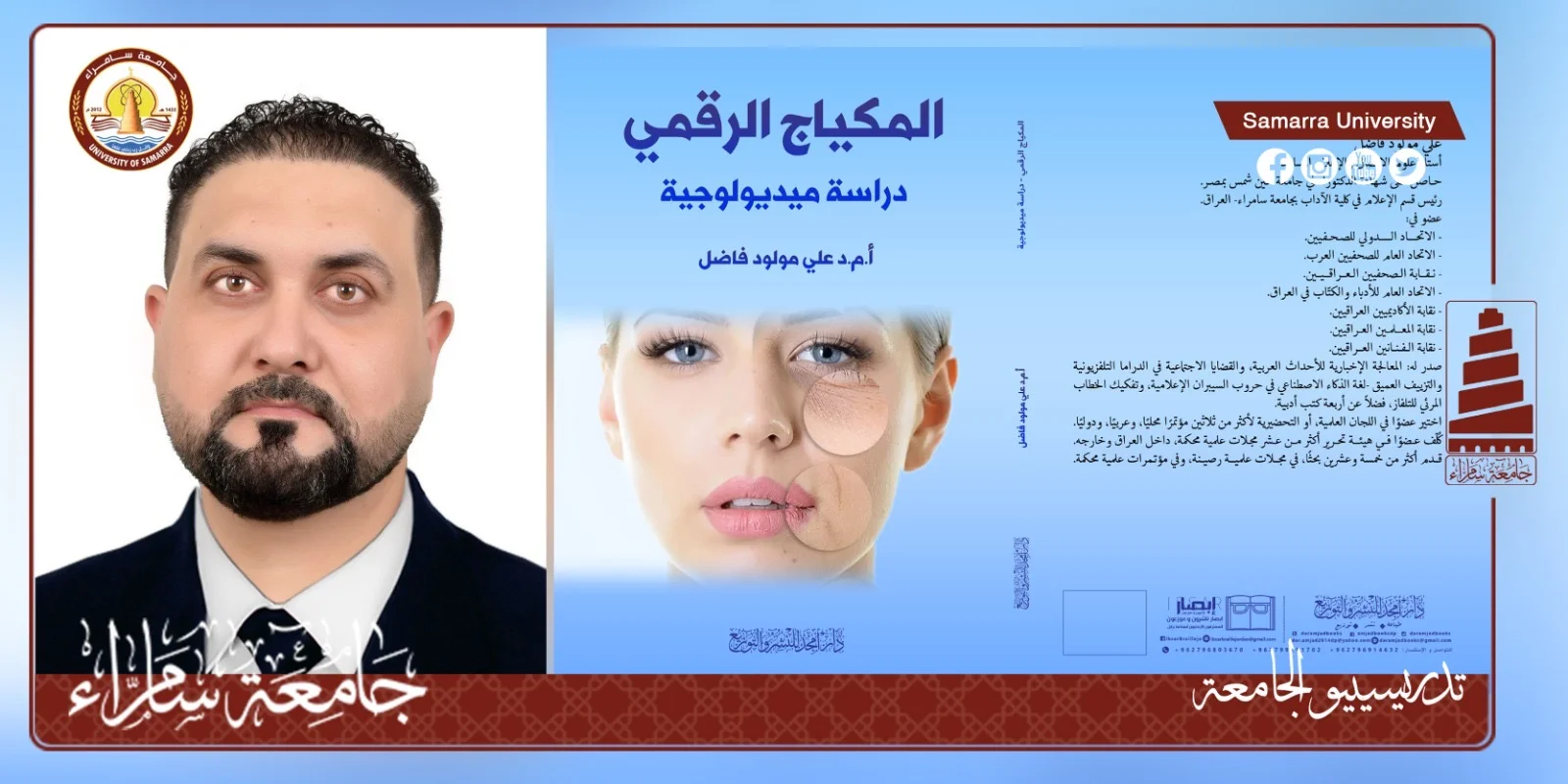
Assistant Professor Dr. Ali Mawlood Fadel Discusses Digital Makeup in His New Book
Assistant Professor Dr. Ali Mawlood Fadel, a distinguished figure in the field of media and communication sciences and the Head of the Media Department at the College of Arts at the University of Samarra, has released a new book of around 200 pages. The book, published by Dar Amjad in Amman, Jordan, in its first edition at the end of August 2024, explores “digital makeup” through a radiological study.
At the beginning of the book, the author provides a comprehensive review of the history of makeup across different eras and civilizations, highlighting how cosmetics have been present since ancient times, with the aim of beautifying and softening faces. The book also discusses the evolution of makeup, distinguishing it from beauty enhancement, and covers cosmetic procedures and their types, as well as the reasons behind them.
Additionally, Mawlood explores the stages of image development, tracing its beginnings and the advancements that led to digital imaging. He also examines the relationship between “montage and makeup,” a topic requiring serious scientific discussion.
The third chapter presents social media platforms that offer features to alter human features, starting with Snapchat. The author describes how Snapchat’s filters create a “Snapchat personality”—an artificial persona generated by filters, scientifically known as digital filters, created by application algorithms in collaboration with artificial intelligence. These filters craft features that users wish they were born with. According to the book, the use of filters has increased the rates of cosmetic surgeries among both genders, with a higher prevalence among women, as they seek to match their natural appearance with their filtered images. Other platforms like Facebook, Instagram, TikTok, and others have followed suit, introducing filters that project unrealistic features onto people’s faces.
The book concludes with a definition of digital makeup, which has replaced traditional makeup. While the latter involves cosmetic products, the former is created through digital filters. These filters lead to the construction of a personality that lacks confidence in its features and is dissatisfied with its appearance. The widespread use of digital deception is a consequence of the prevalence of these unrealistic features.
The Department of Media and Government Communication congratulates Dr. Ali Mawlood Fadel on his new scholarly achievement, which is considered a new addition to the field of digitalization. The book addresses a crisis experienced by many communication professors who observed the emergence of new phenomena during the last millennium.
It is worth noting that the author has presented topics and insights that could serve as important subjects for future scientific studies in the field of communication and media, which we hope will inspire and benefit students and researchers in the field of media and communication sciences.


