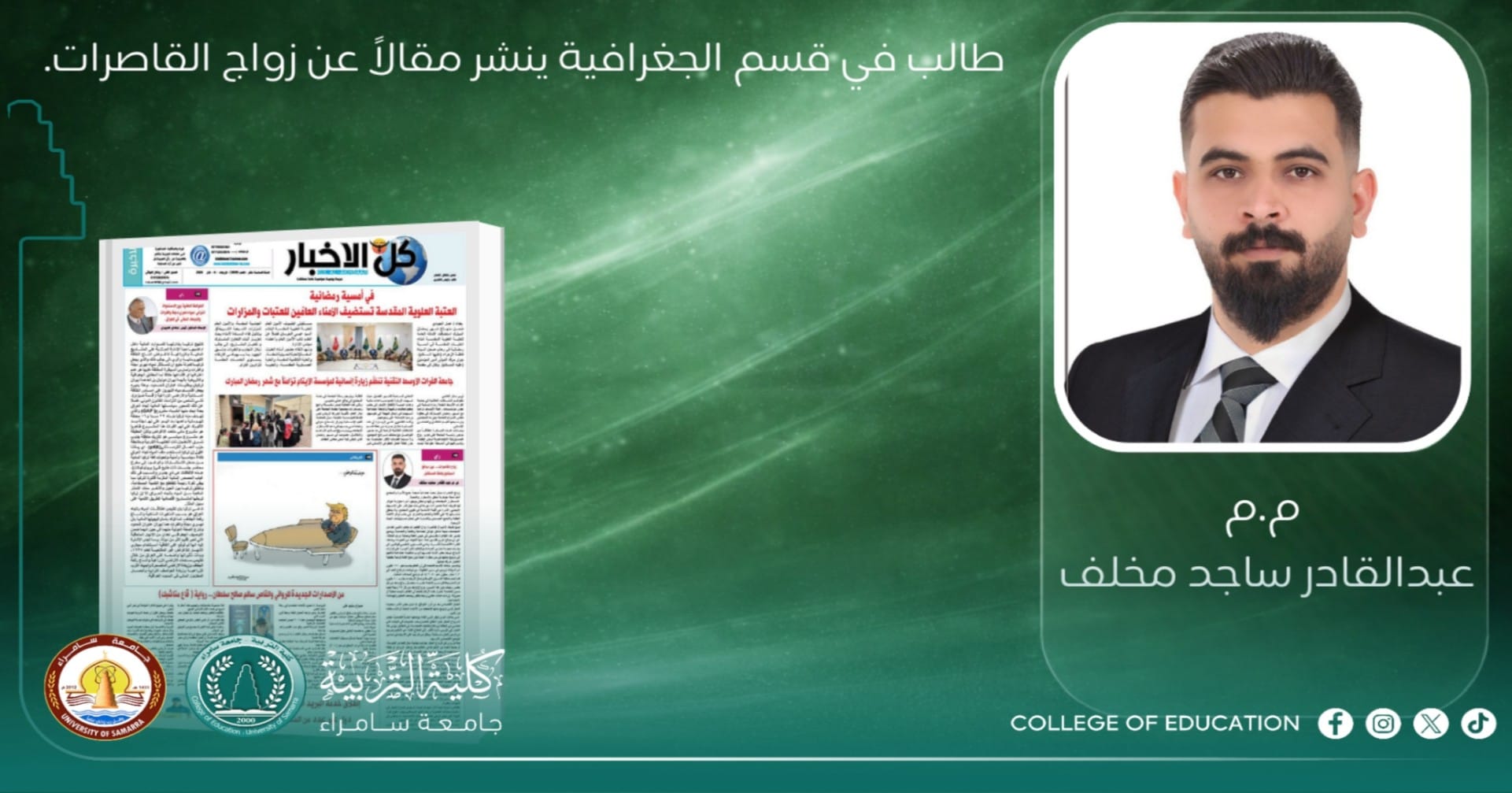
A Geography Student Publishes an Article on Child Marriage
A PhD student in the Department of Geography at the College of Education for Human Sciences – University of Samarra, Assistant Lecturer Abdul Qader Sajid Makhlif, published an article titled “Child Marriage… Between Social Motives and the Cost of the Future” in Kul Al-Akhbar newspaper, issue No. (3859). In the article, he reviewed the dimensions of this social phenomenon and its reflections on the structure of society and the future of development.
The researcher focused on the relationship between social stability and the formation of a balanced family capable of fulfilling its role in raising an aware and responsible generation. He explained that mental competence and physical maturity constitute an essential foundation for assuming the responsibilities of married life and for building a relationship based on understanding and mutual respect.
From this perspective, he presented a set of factors that contribute to the persistence of the phenomenon of child marriage, including social, cultural, and economic conditions, as well as the influence of customs and traditions in some communities that encourage marrying girls at an early age. In addition, he pointed to the low educational level and the economic challenges faced by some families as contributing factors.
In a related context, the researcher referred to international statistics that reveal the widespread nature of this phenomenon worldwide, highlighting its social, health, and demographic consequences. These include higher probabilities of divorce, depriving girls of the opportunity to continue their education, and the health risks associated with pregnancy at an early age.
The researcher concluded his article by emphasizing the importance of adopting comprehensive approaches to address this phenomenon, including supporting girls’ education and economically empowering families, as well as promoting community awareness of the importance of maturity and informed choice in building a family. He stressed that protecting childhood represents a fundamental pillar in achieving a more stable and just society.