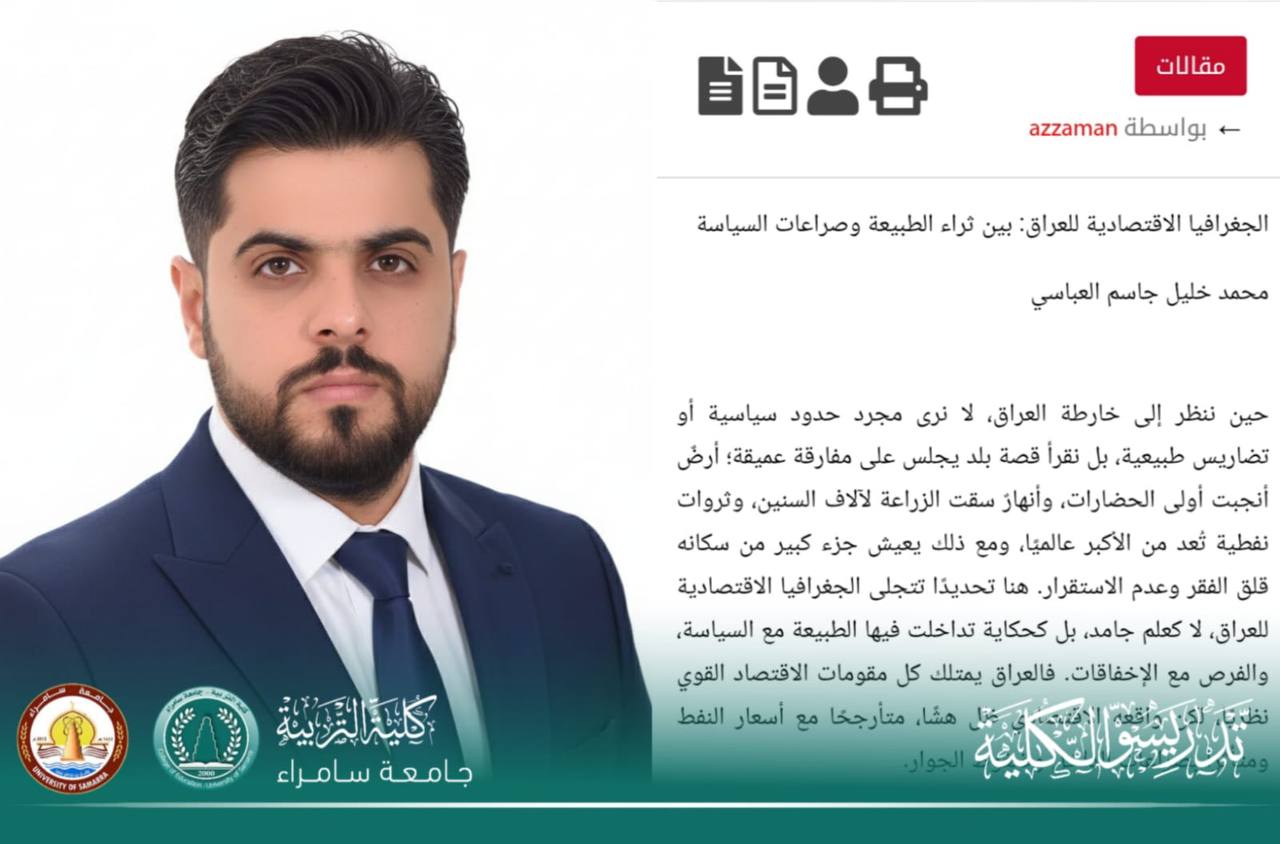
A Lecturer at the Department of Geography, University of Samarra, Publishes an Intellectual Article in Al-Zaman Newspaper
Dr. Mohammed Khalil Jasim, a lecturer at the Department of Geography, College of Education – University of Samarra, has published an analytical article in the Iraqi newspaper Al-Zaman (Iraq Edition) entitled “The Economic Geography of Iraq: Between Natural Wealth and Political Conflicts.”
In his article, Dr. Jasim presents an in-depth reading of Iraq’s economic geography as a framework for understanding the complex relationship between natural resources and political transformations. He emphasizes that Iraq’s map does not merely represent borders and physical features, but rather reflects a long history of interaction between nature, society, and politics. He explains that Iraq possesses significant economic potential, including a rich civilizational heritage, vital water resources, vast oil reserves, and a unique geographic location. However, the country’s economic reality has remained fragile and heavily influenced by internal conflicts, regional pressures, and fluctuations in global energy prices.
The article highlights that oil, despite being the primary source of state revenue, has turned into a structural imbalance within the Iraqi economy due to near-total dependence on it. This reliance has entrenched a rentier economic system and weakened other productive sectors, particularly agriculture and industry. Consequently, the country has become vulnerable to crises whenever oil prices decline, widening the gap in wealth distribution and deepening citizens’ sense that natural resources are not reflected in their living standards.
In another section, the author discusses the importance of water resources in shaping Iraq’s economic geography, noting that the Tigris and Euphrates rivers have historically formed the foundation of agricultural stability and food security. However, this vital resource now faces mounting challenges, including upstream countries’ water policies, reduced water shares, poor internal management, and climate change. These factors have led to declining agricultural production, the expansion of desertification, and the migration of farmers to urban areas, accompanied by increasing economic and social pressures.
The article also examines Iraq’s geographic location as one of its most significant potential economic strengths. Situated at a crossroads between Asia and Europe, overlooking the Arabian Gulf, and possessing land and sea outlets, Iraq is well positioned to become a regional hub for trade, transport, and energy. Nevertheless, successive wars, sanctions, weak infrastructure, and security instability have kept this advantage outside the sphere of effective investment, while neighboring countries have benefited from roles that Iraq could have played.
Furthermore, Dr. Jasim addresses internal regional economic disparities, pointing to uneven development levels among provinces, service gaps, high unemployment rates, and environmental challenges. These issues, he argues, are the result of accumulated neglect, weak planning, and administrative corruption, which have stripped resources of their developmental value and negatively affected both society and the environment.
In conclusion, the author affirms that Iraq’s economic geography still holds genuine opportunities for recovery. These include economic diversification, revitalizing agriculture and manufacturing industries, developing religious and archaeological tourism, investing in Iraq’s geographic position as a regional corridor, balanced management of water resources, and utilizing desert areas for renewable energy projects.
https://azzaman-iraq.com/content.php?id=117484