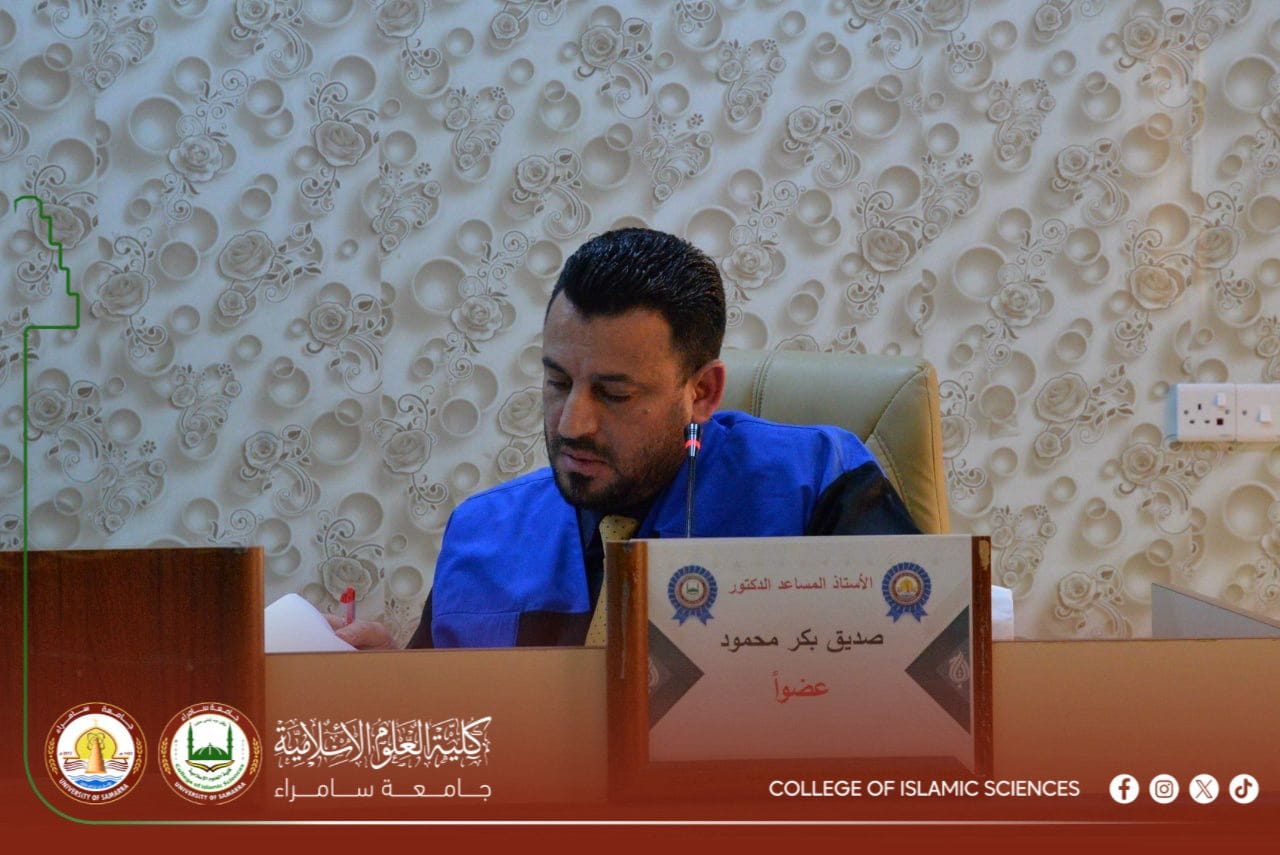
College of Islamic Sciences Discusses a Master’s Thesis by Student Noor Ezz Al-Din Mohi
The College of Islamic Sciences witnessed the discussion of a distinguished Master’s thesis by the student Noor Ezz Al-Din Mohi, titled “The Hamranian Environment and Its Psychological and Social Implications – An Interpretive Study,” which addressed the topic of scientific interpretation of the Holy Quran between methodological foundations and evolving contexts, in the presence of a number of professors, researchers, and postgraduate students.
The thesis aimed to present a rigorous academic vision in the study of scientific interpretation by tracing its methodological foundations and analyzing the stages of its emergence and development over time, with a focus on clarifying concepts and refining related terminology.
The study highlighted, in its findings related to methodological foundations, the importance of formulating the concept of scientific interpretation as an exploratory approach that goes beyond merely reconciling Quranic text with scientific findings, to also employing established scientific facts in uncovering the universal meanings embedded in the Quranic discourse. It also emphasized the need to distinguish between “scientific fact,” which has reached experimental certainty, and “hypothesis,” which remains under investigation, in order to preserve the sanctity of the Quranic text from being tied to changing human knowledge.
In another aspect, the thesis examined the historical development of scientific interpretation, demonstrating that it is not a modern phenomenon but has roots in early reflective traditions within Islamic heritage, later evolving into a structured approach in the modern era as a response to contemporary intellectual challenges, particularly materialistic trends.
At the conclusion of the discussion, the examination committee praised the scientific effort presented in the thesis, noting its depth of analysis and methodological precision, and emphasized its importance in enriching Quranic studies and opening new horizons for research in the field of scientific interpretation.