Symposium at the College of Engineering Discusses Risks of Groundwater Rise on Soil and Structures
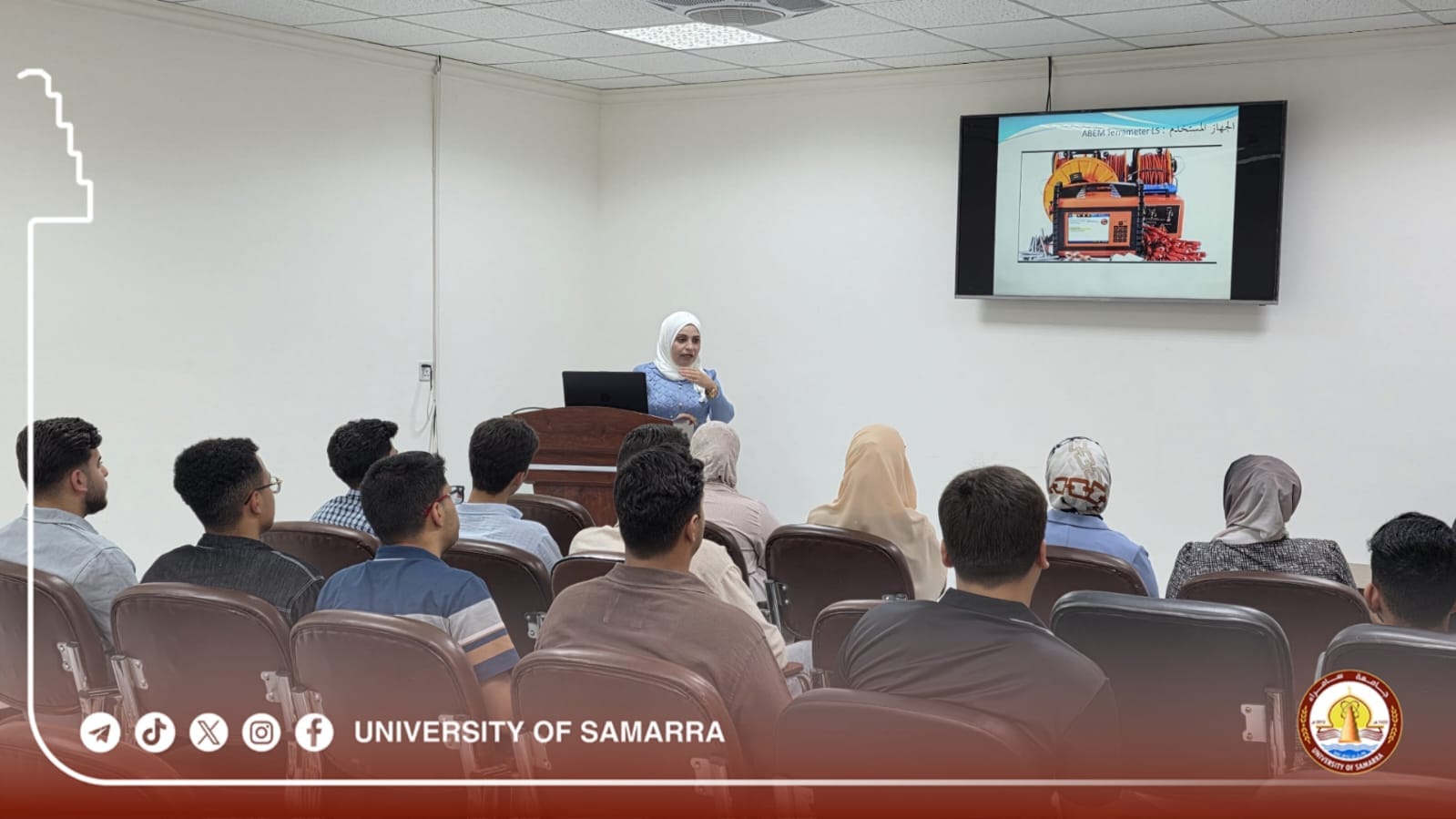
The College of Engineering at the University of Samarra discussed \”Assessment of Groundwater Levels in Some Neighborhoods of Samarra City and Their Geological Impact\” in a scientific symposium presented by Assist. Lect. (Ruqayyah Zahim Khalaf), utilizing geophysical techniques.
Ruqayyah explained the structural and environmental challenges resulting from the rise in groundwater levels and their direct impact on the engineering properties of soil in the city, which is located on an unstable platform.
The lecturer presented the results of using 2D electrical resistivity imaging (ERI) via the ABEM Terrameter LS device and data analysis using RES2DINV software. This involved studying four critical sites, which revealed variations in the depths of the main aquifer, appearing at levels ranging between (16) and (17) meters. Subsurface water accumulations were also observed at some sites, starting from very shallow levels close to the ground surface, particularly in the \”Police Neighborhood,\” which showed a clear groundwater depression compared to adjacent areas.
It is noted that fluctuations in water levels and increased humidity lead to weakened soil cohesion and the emergence of complex geological problems, including the swelling of clayey soils and dissolution of minerals in gypsum-rich soils. This causes the formation of subsurface voids and land subsidence, threatening the stability of foundations and structures, necessitating the adoption of engineering solutions and precise geotechnical treatments to mitigate the deterioration of soil stability in affected areas.