Two lecturers from the University of Samarra publish a joint scientific research paper in a journal indexed in Scopus.
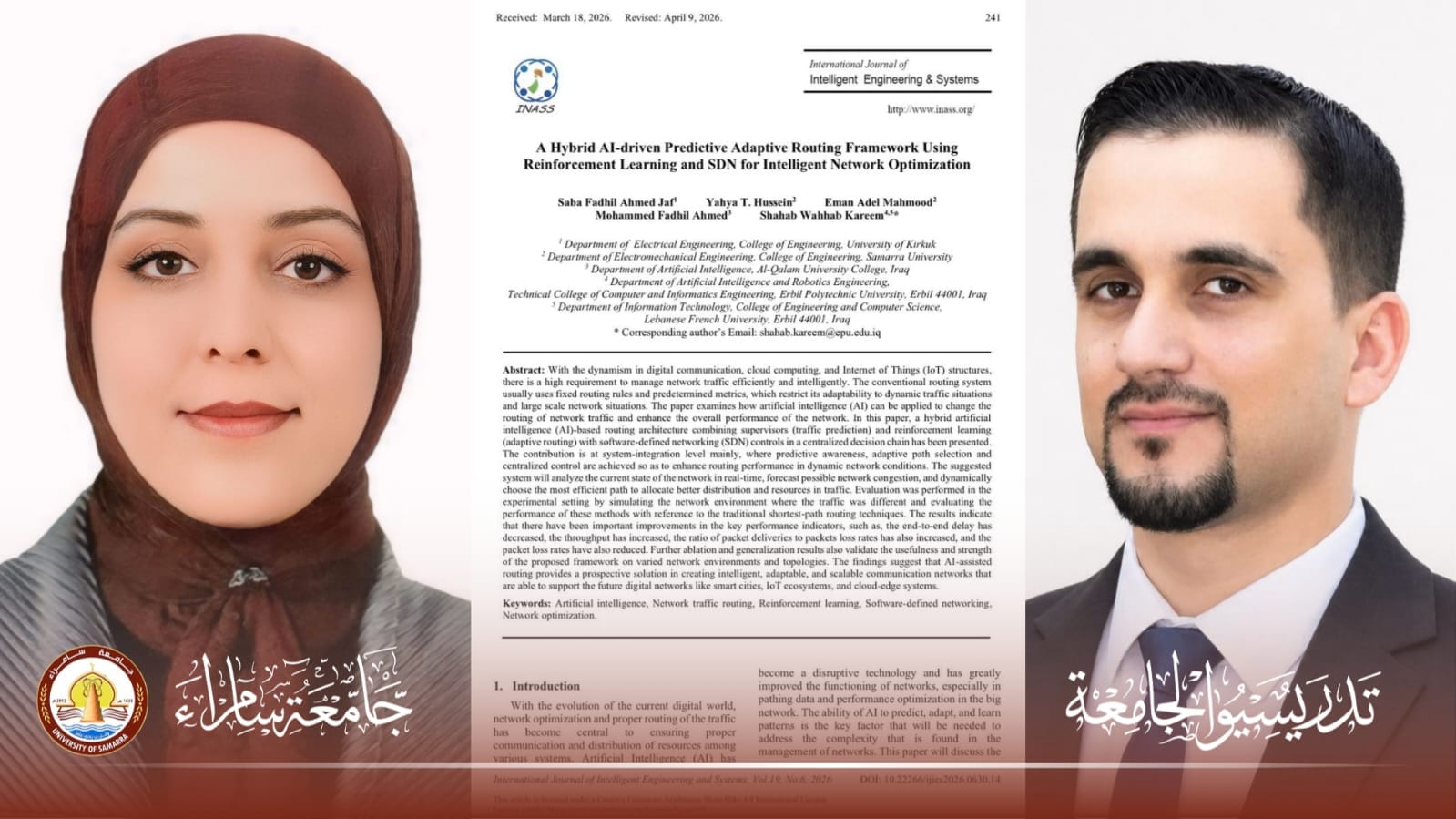
Dr. Yahya Tariq Hussein and Assist. Lect. Iman Adel Mahmoud, lecturers at the College of Engineering, University of Samarra, have published a joint scientific research paper in the International Journal of Intelligent Engineering and Systems, issued in Japan and classified in the second quartile (Q2) of the Scopus index.
The research is titled ‘An AI-Driven Hybrid Predictive Adaptive Routing Framework Using Reinforcement Learning and Software-Defined Networking (SDN) for Smart Grid Optimization,’ in which they presented an innovative solution to the shortcomings of traditional routing protocols and their inability to handle large-scale dynamic networks, coinciding with the rapid surge in digital communications and cloud computing, especially Internet of Things (IoT) applications.
The researchers proposed an intelligent routing system based on artificial intelligence techniques, uniquely integrating proactive prediction of data movement, adaptive routing via reinforcement learning algorithms, and centralized control using Software-Defined Networking (SDN). This enables the system to instantly analyze the network status, predict bottlenecks before they occur, and dynamically select optimal alternative paths for load distribution.
Simulation results and rigorous tests showed a notable and significant improvement in overall network performance, represented by reducing latency to minimum levels, increasing throughput, raising the efficiency of data packet delivery and reducing packet loss, in addition to demonstrating the model’s robustness and its high ability to adapt and generalize across diverse network environments, confirming its readiness to be a pioneering practical solution in the management and operation of future smart grids.
In turn, the Media and Government Communication Department congratulates the lecturers at the College of Engineering on their distinguished scientific output, wishing them continued success in their academic and research careers.