Researchers at the University of Samarra Co-Author a Book on Electrical Engineering, Computer Science, and Mathematics
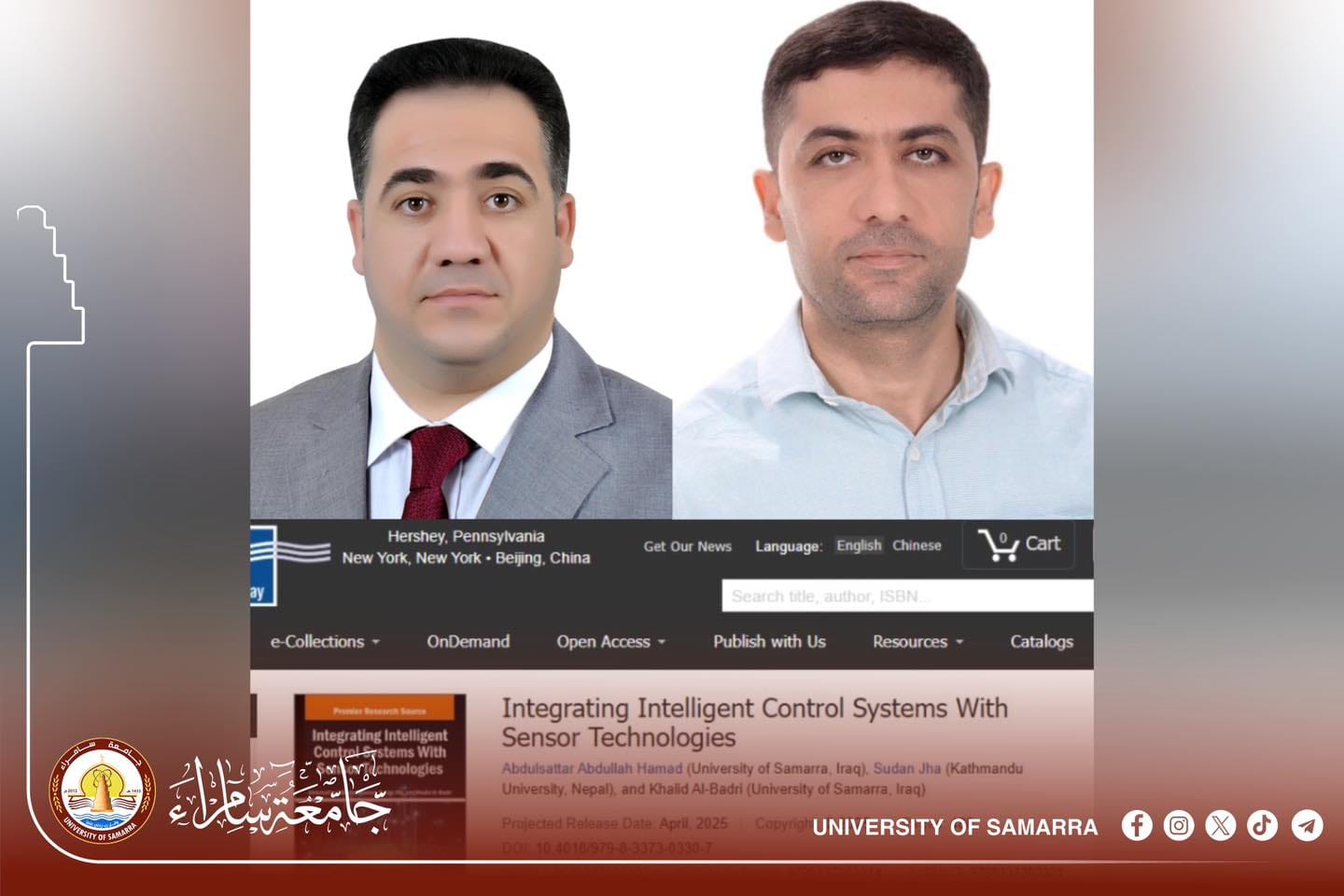
Assistant Professor Dr. Abdul Sattar Abdullah Hamad and Assistant Professor Khalid Saeed Al-Taif, faculty members at the University of Samarra, have co-authored a scientific book in collaboration with a researcher from Kathmandu University in Nepal. The book is titled “Integration of Intelligent Control Systems with Sensing Technologies.”
The book was published this April by IGI Global, a U.S.-based publisher listed in Scopus and Clarivate indexing databases. It serves as a high-quality reference in the fields of mathematical dynamic systems, artificial intelligence, and modern intelligent systems.
Spanning twelve chapters, the book presents recent advances in integrating intelligent control algorithms with advanced sensing technologies, using modern mathematics and dynamic systems. It focuses on enhancing precision and efficiency in various fields such as industrial automation, healthcare, smart networks, and environmental monitoring.
The chapters also cover the design and development of innovative sensors and actuators using advanced mathematical models and numerical analysis algorithms to boost accuracy and efficiency. Additionally, the book addresses the integration of dynamic systems and multi-source data analysis through mathematical models based on differential equations and numerical transformations, alongside smart sensors and Internet of Things (IoT) applications, offering a mathematical study of data flow and signal processing.
The book targets academic researchers, graduate students, and professionals in electrical engineering, computer science, and modern mathematics, as well as specialists in mechanical engineering, information systems, policymakers, and innovators interested in the applications of intelligent control technologies.
The Department of Media and Government Communications at the University of Samarra congratulates the university’s professors on their achievement, wishing them continued success in their academic and research endeavors.