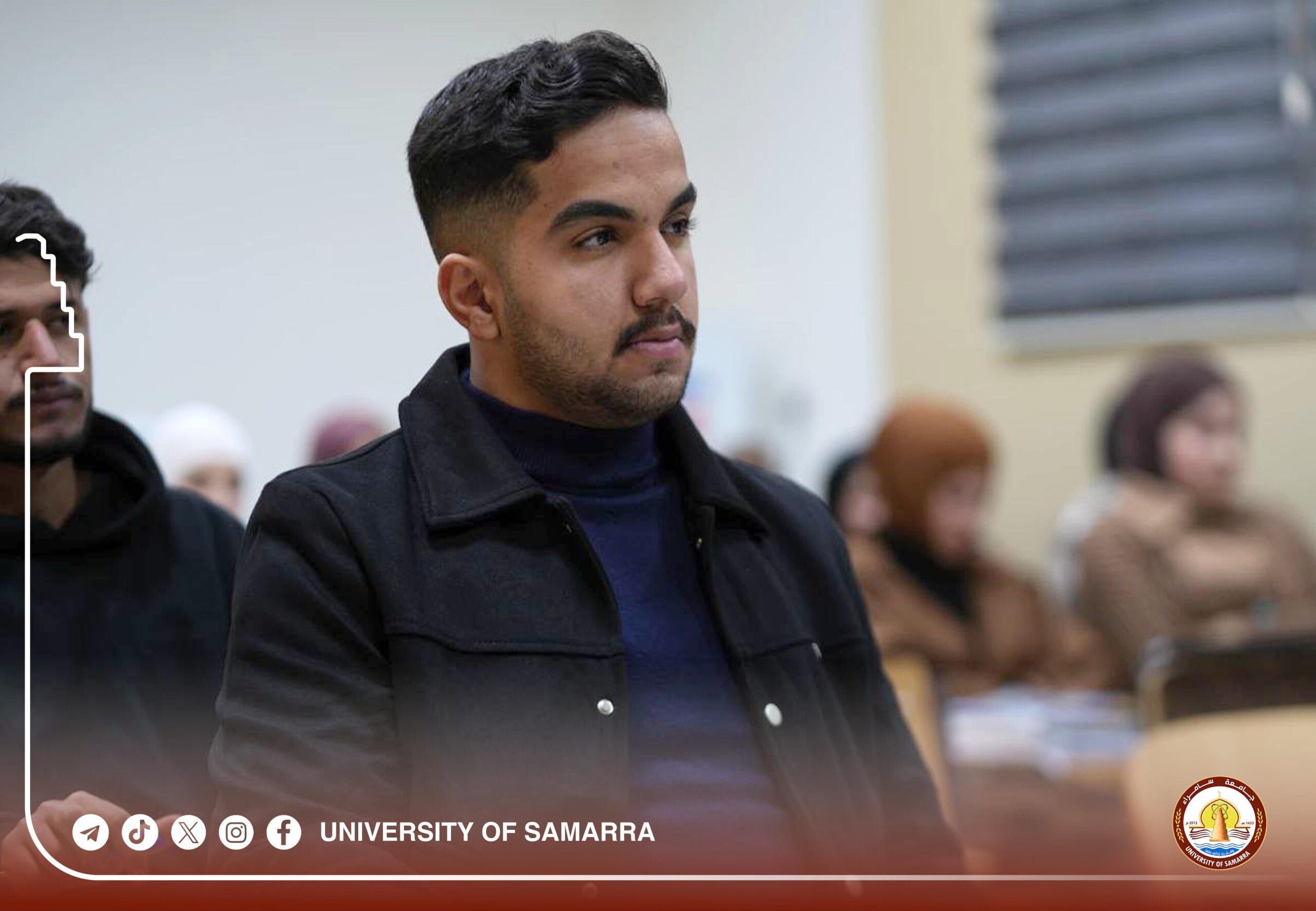
Department of Geography Organizes a Scientific Symposium on the Role of GIS in Improving Public Health
The Department of Geography at the College of Education for Human Sciences, University of Samarra, organized a scientific symposium titled “The Role of Geographic Information Systems (GIS) in Improving Public Health and the Spatial Variation of Diseases.”
The session was presented by Dr. Nour El-Din Faisal Ibrahim, Assist. Lect. Shaiban Diyab Ali, and Assist. Lect. Khalaf Fadhil Ali.
The lecturers focused on the importance of Geographic Information Systems as an advanced analytical tool that contributes to understanding the spatial distribution of diseases and detecting their geographical patterns, thereby supporting decision-makers in effective health planning.
In a geographical context, Nour El-Din explained the mechanism of using GIS to determine the geographical distribution of diseases, identify “hotspots,” and analyze the spatial and temporal variation of infection and mortality rates.
Meanwhile, Shaiban demonstrated the relationship between diseases and environmental, demographic, and social factors. He also highlighted the role of GIS in planning health institutions, evaluating the efficiency of service distribution, managing epidemics and infectious diseases, and supporting health prevention and awareness programs.
For his part, Khalaf added that Geographic Information Systems represent a strategic tool for transforming health data into analytical maps that facilitate the interpretation of disease phenomena and provide a scientific basis for making health decisions based on the spatial dimension.
It is noted that this symposium was held to clarify scientific and health concepts and link them to geography, contributing to the improvement of public health, the reduction of health risks, and the achievement of sustainable and balanced health development.